

ST-IF-001 — INVOICE FORENSICS — SYNTERMINAL
Right now, is anyone
checking every single
line of every invoice?
You run jobs. You manage suppliers. Invoices arrive and get paid. Your supplier's billing system was built knowing nobody checks every line against every quote. That is exactly where Synterminal operates — and what we find when we look is not what most people expect.
// fixed scope · no percentage of recovery · findings tied to source documents · scope quoted same day
68%
Overcharge rate
live engagement
live engagement
74.9%
Lines not on
any quote
any quote
153
Substitution patterns
2 months · 1 supplier
2 months · 1 supplier
3 days
First findings
delivered
delivered
Trade Contractor
Electrical · HVAC · Plumbing · Landscape · Roofing · Solar
↗
Supplier / Distributor
Electrical Supply · HVAC Dist. · Plumbing · Building Materials · MRO
↗
Manufacturer
Steel Fab · Electrical Components · HVAC Equipment · Pipe & Fittings
↗
Mine / Refiner
Copper · Gold · Lithium · Iron Ore · Smelter · Refinery · EPCM
↗
Transport / Freight
Freight Broker · Trucking · Last-Mile · Cold Chain · 3PL
↗
No-Quote Audit
No Written Quote · Verbal Estimate · T&M · Any Operator
↗
Other Operators
Government · Hospitality · Healthcare · Property · Restaurant · Retail
↗
Not Sure Where to Start?
Describe your operation. We scope it same day.
↗
// ST-IF-CRM — YOUR ACCOUNT · YOUR SYSTEM · YOUR FINDINGS
This is what you get access to.
When you open an engagement with Synterminal, you are not waiting on a report. You get a live account — a purpose-built system where every invoice you send us, every quote on file, every finding we document, and every export we produce sits in one place. Organized by supplier. Organized by job. Visible to your whole office. No IT department required. No per-seat pricing. One flat monthly rate based on your invoice volume.
Most clients start with one supplier. Usually the highest-volume one, the most suspect one, or both — because in our experience those tend to be the same supplier. You send us what you have. We organize it, run the analysis, and you start seeing findings within three days.
3
Days to first findings
∞
Seats — everyone in your office
1
Supplier to start — the one that feels wrong
0
IT installs — browser-based, works on any device
// INSIDE YOUR ACCOUNT — SWIPE TO EXPLORE
1 / 5
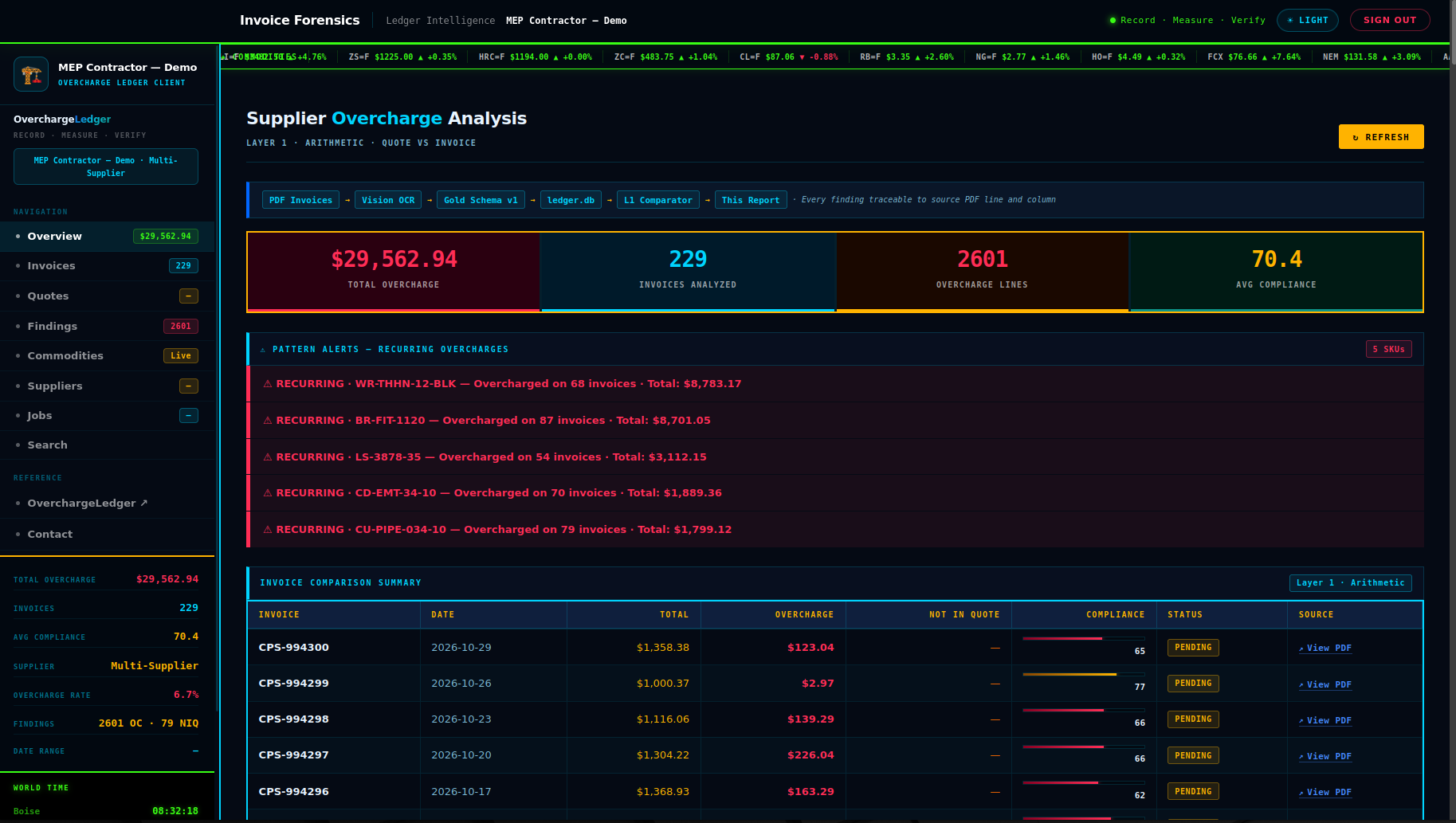
INVOICES
Every invoice your office sends us appears here — numbered, dated, total billed, overcharge amount flagged in red, compliance score, and a direct link to the original PDF. Nothing falls through the cracks. Your AP team sees exactly where every document sits at any time.
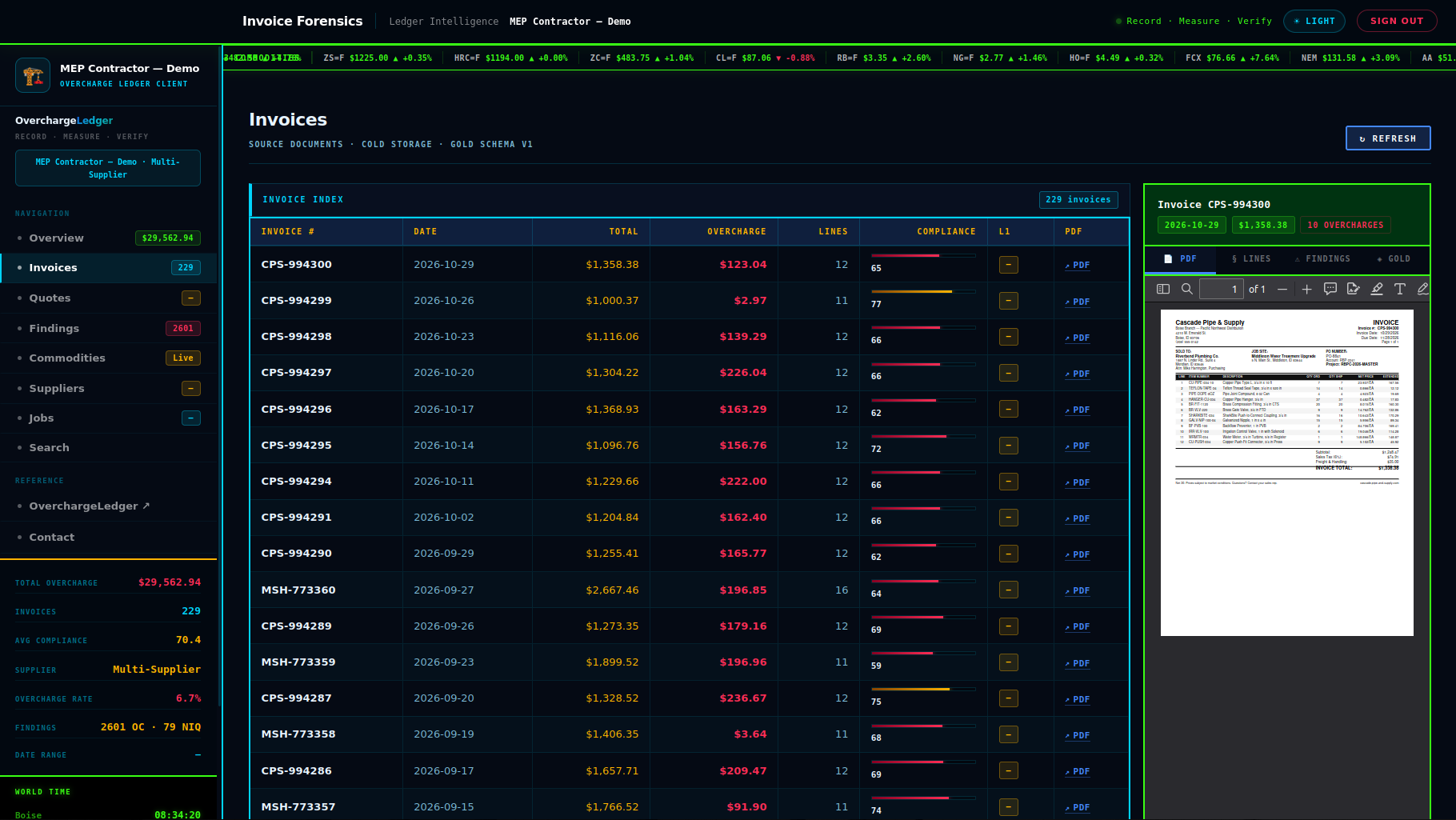
QUOTES
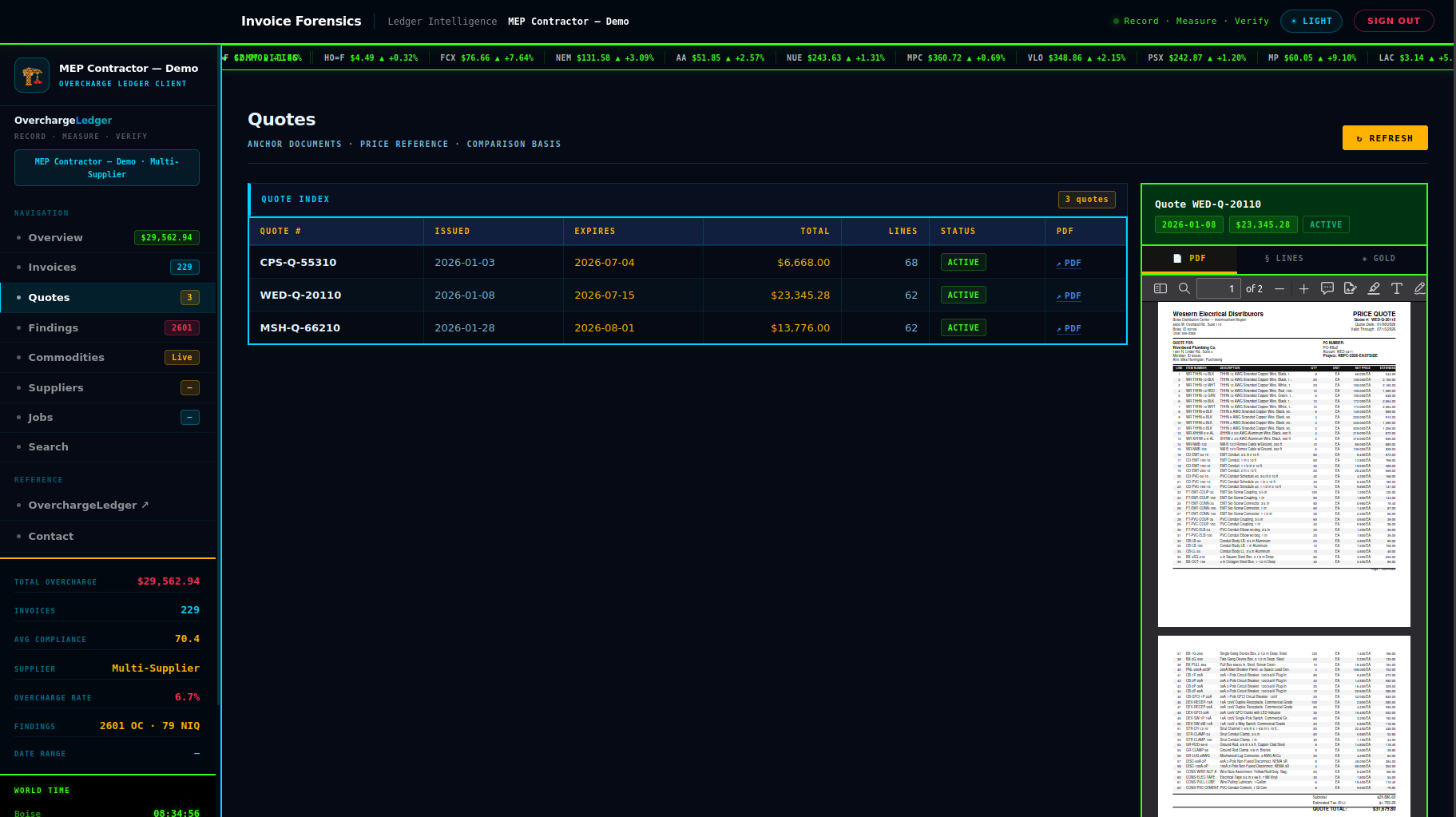
Every quote your supplier gave you lives here — organized by supplier, with issue date, expiration date, line count, and the original PDF inline. We track expiration dates and flag quotes approaching their end so you always know whether you are buying under an active agreed price or not.
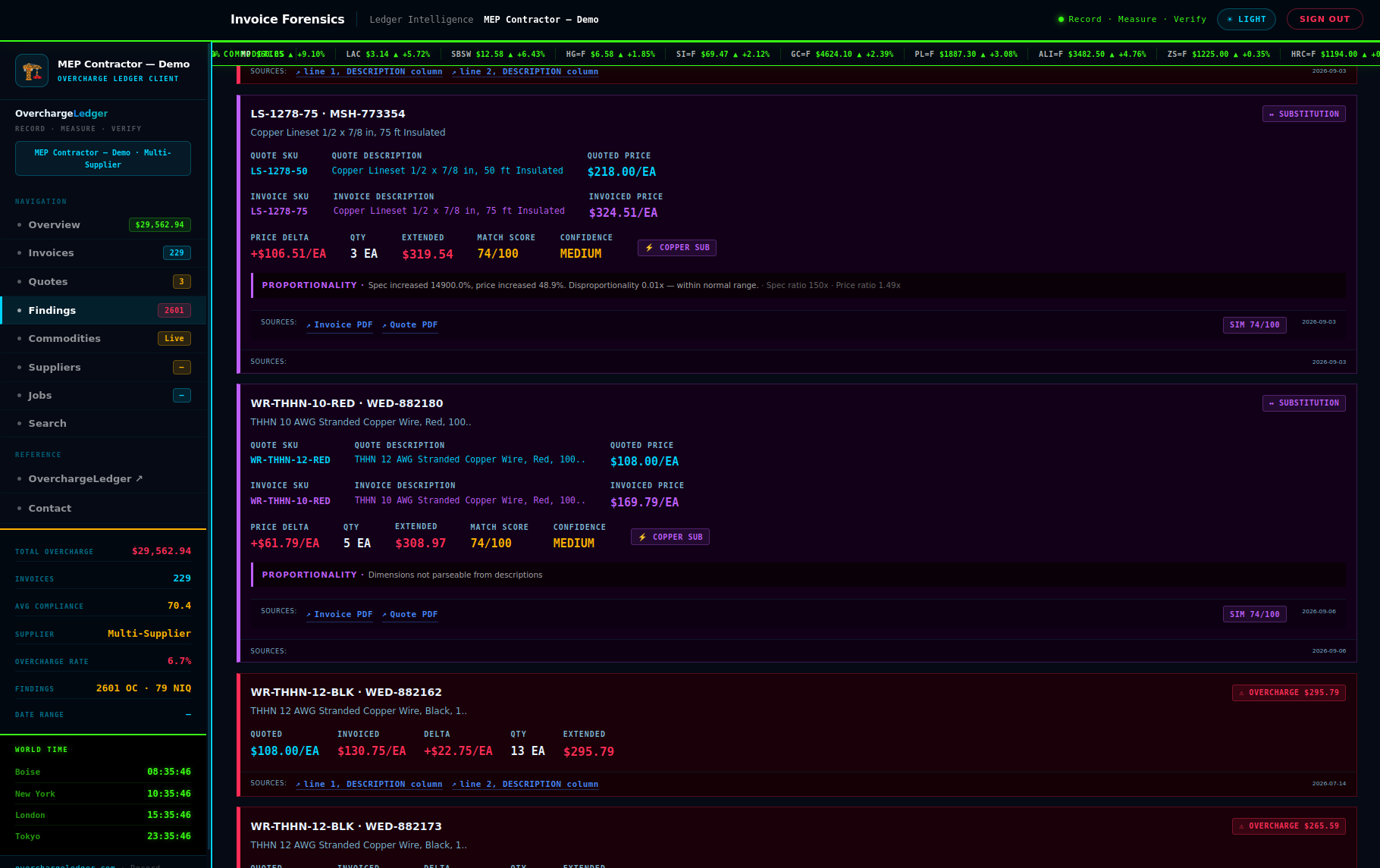
FINDINGS
Every overcharge documented — the item, the quoted price, the invoiced price, the delta per unit, the quantity, the total impact. Every finding is sourced to the exact line of the exact invoice and the exact quote it was compared against. One click opens the source PDF. Export directly to CSV, PDF report, or formatted text for your attorney.
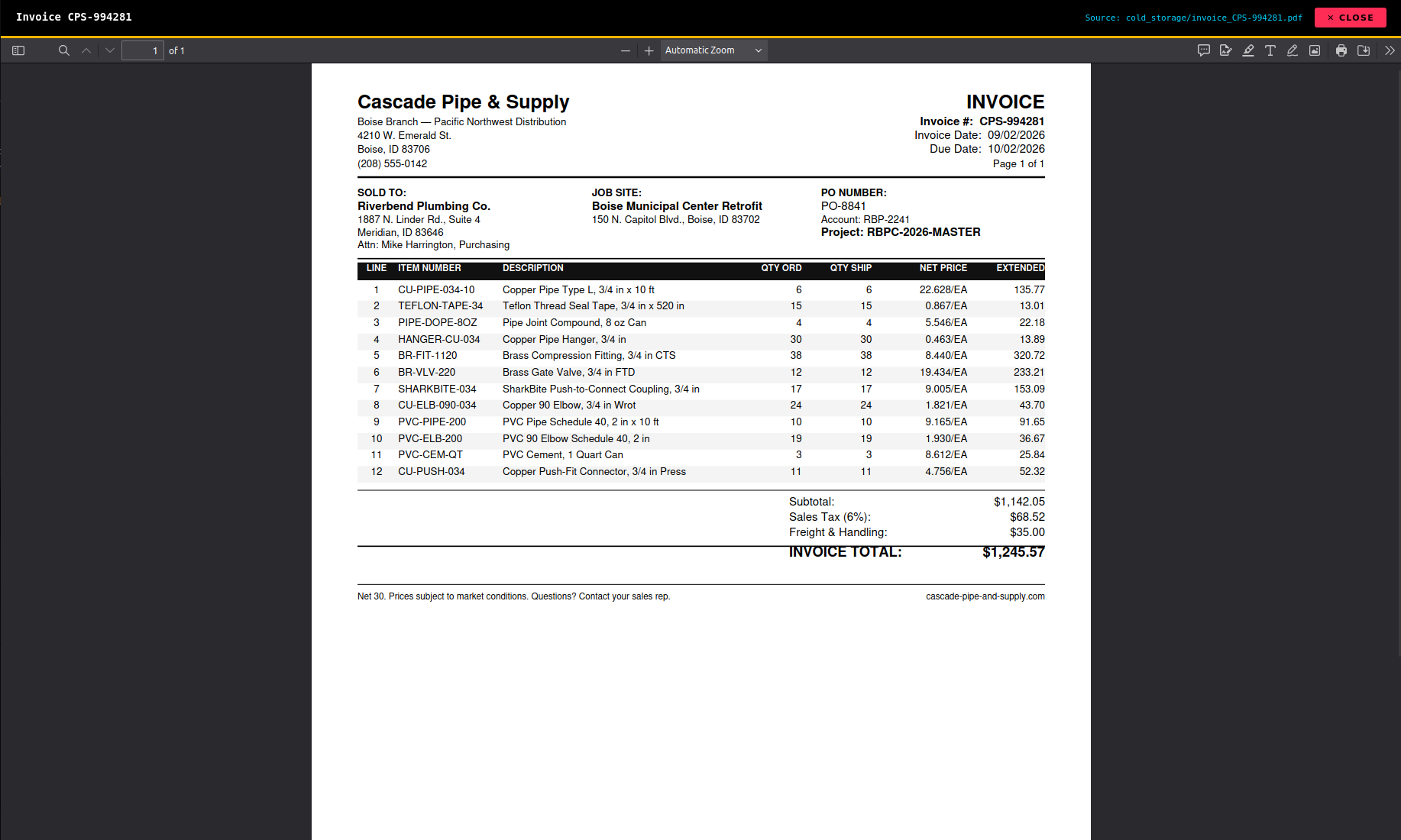
COMMODITY INTELLIGENCE
Live spot prices for the commodities that make up what you buy — copper, steel, aluminum, PVC resins, natural gas, and more. Every price sourced and timestamped. When your supplier tells you prices are up "because of the economy," you will already know whether that is true — and by how much.
DOCUMENT SEARCH
Every document ingested into your account is searchable — invoices, quotes, contracts, specs, even scanned PDFs. Type a part number, a supplier name, a line item description, or a plain English question. Synterminal finds it. Your entire document history becomes a searchable record you can interrogate at any time.
// WHAT EVERY ACCOUNT INCLUDES
Invoice & Quote Management
Every document organized by supplier and by job. Status tracked from receipt through analysis. Original PDFs always accessible. Nothing gets lost. Nothing gets skipped.
Quote Expiration Alerts
Quotes have expiration dates. When one is approaching — thirty days out, one week out — your account flags it. You never unknowingly buy materials against an expired quote with no agreed price on record.
Findings & Export Package
Every overcharge documented with source. NIQ CSV for your supplier. PDF Report for your attorney. Findings MD for your records. Every export is a weapon with a specific audience. You choose which one you need and when.
Commodity Intelligence
Live spot prices for the raw materials underneath what you buy. Sourced, timestamped, mapped to your invoice categories. When your supplier raises prices, you already know whether the commodity moved — and by how much.
Document Search
Every ingested document is searchable — invoices, quotes, contracts, specs, blueprints, scanned images. Search by part number, supplier name, line description, or plain English. Your entire document history becomes a record you can interrogate.
Unlimited Seats · One Price
Your project manager, your AP coordinator, your estimator, your owner — everyone in your office gets access. Pricing is based on invoice volume, not headcount. No per-seat charges. No user limits.
// NOT ONE SIZE FITS ALL — ST-IF-CRM-002
Same architecture.
Different intelligence surface.
Different intelligence surface.
Every account is built on the same proven skeleton. What changes is the surface — the tabs, the analysis types, the export formats, and the things we watch for. Before we build your account, we talk to you. We ask what you look for. We ask what has felt wrong. We ask what your AP team has already caught — because that tells us where to look first. The system that comes out of that conversation is built for your operation, not a template we copied from the last client.
Trade Contractor
Electrical · HVAC · Plumbing · Landscape · Roofing · Solar · Concrete
Invoice vs quote at the line level. SKU substitution detection. Grade and size mismatch flags. Not-in-quote export for supplier negotiation. Job folder organization so findings map directly to the job they hit. Quote expiration calendar so you never buy unpriced.
General Contractor
Public Works · Commercial · Multi-Trade · Subcontractor Management
Portfolio-level monitoring across multiple active jobs and multiple subcontractor invoices simultaneously. Change order tracking against original scope. Subcontractor billing pattern analysis. Compliance scoring across your full AP queue — not just one supplier at a time.
Manufacturer
Steel Fab · Electrical Components · HVAC Equipment · Pipe & Fittings · Plastics
Input cost monitoring against commodity spot prices. Bill of materials invoice cross-check. Supplier pricing drift tracked over time. Tariff exposure mapped against your material categories. Every price move on your inputs visible before it lands on an invoice.
Mine / Refiner
Copper · Gold · Lithium · Iron Ore · Smelter · Refinery · EPCM
Capital project contractor invoice analysis. EPCM billing verification against scope documents. Commodity price cross-check against input purchase invoices. Force majeure and change event documentation. Large-scale document corpus with full-text search across project records.
Law Firm
Construction Defect · Contract Dispute · Fraud · Procurement Litigation
Evidence-grade document corpus. Every finding sourced to exact PDF line and column with cryptographic timestamp. Expert-ready PDF report formatted for deposition or discovery. Entity monitoring on counterparties. Counterparty invoice and pricing history assembled for litigation support.
Property Manager · Hospitality · Other
Multi-Location · Restaurant Group · Real Estate · Insurance · Government
Vendor invoice analysis across multiple locations or properties simultaneously. Service contract billing verification. Repeat vendor pattern monitoring. The analysis runs the same regardless of industry — if you receive invoices and have contracts or quotes to compare them against, the system runs.
The conversation before we build your account costs nothing. Describe your operation, your suppliers, and what has felt wrong. We will tell you plainly what we can find and how long it takes. No commitment required to have that conversation.
OPEN AN ENGAGEMENT ↗
// THE REAL FINDING — WHAT THIS SERVICE ACTUALLY IS
You probably already have someone checking invoices. Or you're doing it yourself. Or you did it for a while and stopped — because keeping every quote, every line item, every SKU, every price in your head while you're running crews and hitting deadlines is a full-time job that nobody has time for. That's not a failure of your office. That's the environment your supplier's billing system was designed to operate in.
Synterminal doesn't just find overcharges. You can find those with enough time and a spreadsheet. What we find is the hidden logic running underneath — the pricing behavior your supplier's system is actually executing, systematically, across every order, every job, every month. The pattern is what matters. Because the pattern tells you this isn't accidental.
We take every engagement seriously because of how far back some of these patterns actually go. The dataset we're about to show you covers two months. The pattern shows no sign of being new. We don't know when it started. Neither does the client. That's the point.
Have you — or anyone in your office —
ever actually seen this pattern
in your invoices?
in your invoices?
We can almost guarantee it's in there. The mechanism is the same whether you buy electrical supply, irrigation fittings, HVAC components, plumbing materials, or industrial hardware. Wherever a supplier runs a digital catalog and a contractor runs jobs from quotes, the gap between the two is where this lives.
Suppliers have told us directly.
Not every supplier, not every rep — but we have heard, from people inside
these organizations, that they know the discrepancies are in the system.
They just hope you don't find them. The invoice gets paid.
The pattern continues. Nobody asks the question.
Synterminal asks every question, on every line, every time.
// HOW THE PATTERN WORKS — IN PLAIN LANGUAGE
Your estimator builds the quote request. The supplier returns pricing. You build the bid. You win the job. The job runs. The superintendent needs a 2-inch PVC 45-degree elbow on a Friday afternoon. The branch pulls what's available. The order goes in. The invoice comes back.
On the invoice: 2" Sch 80 PVC 45° Elbow. $13.53.
On your quote: 2" Sch 40 PVC 45° Elbow. $2.27.
The description is 99% identical. The SKU is different.
The price is 5.97 times higher.
Does Schedule 80 cost more than Schedule 40? Yes. It's a heavier wall — higher pressure rating. It does cost more. But how much more is defensible? A dollar? Two dollars? Because the actual cost difference between Sch 40 and Sch 80 in a standard 2-inch PVC elbow is not eleven dollars. The size difference is real. The price difference is not proportional — not even close.
And here's what makes it invisible: nobody at the job site is going to stop and check the schedule rating on a fitting. It goes in the same hole. It fits the same pipe. The crew installs it. The invoice gets approved. The pattern repeats on the next job. And the one after that.
Quoted unit price — 2" Sch 40 PVC 45° Elbow
$2.27
Invoiced unit price — 2" Sch 80 PVC 45° Elbow
$13.53
Unit delta
+$11.26 per unit
Quantity on this invoice line
46 units
Impact — one line item
$518.10
That is one pattern. We found 153 of them. Two months. One supplier. Each one hiding in plain sight — described in nearly identical language to what was quoted, different enough in the SKU that no manual review would catch it at volume.
// THE QUESTIONS YOUR SUPPLIER DOESN'T WANT ASKED
Before you pay that invoice,
five questions nobody is asking.
01
Was the substituted item on the approved quote?
If Sch 80 was never quoted, there is no agreed price for it.
It goes on the not-in-quote list. The supplier set the price unilaterally.
There was no ceiling.
02
Was a change order submitted?
If field conditions required a different spec, that's a documented conversation —
approved, priced, signed. Not a silent SKU swap on an invoice.
03
Did the job actually require the upgrade?
Sch 80 is a higher-pressure fitting used in specific applications.
If the spec called for Sch 40, why did Sch 80 arrive?
Who made that decision? When?
04
Was the substituted item actually delivered?
We found patterns in this dataset where the substitution was mapped
in the billing system — with a quantity of zero. Nothing shipped.
The pricing logic ran anyway.
05
Is the price multiplier proportional to the actual cost difference?
Sch 80 is not 600% more expensive to manufacture than Sch 40.
The wall is thicker. The material cost is higher — modestly.
Not by a factor of six.
Synterminal asks all five questions simultaneously, across every line item, every invoice, every job — and produces a documented finding for each one that doesn't have a clean answer. When the owner takes that documentation to the supplier, the conversation is different.
// GRADE SUBSTITUTION PATTERNS — VERIFIED · GRADE-ONLY · SAME SIZE · SAME FITTING TYPE
SCH 40 → SCH 80 · IDENTICAL DESCRIPTION · PRICE MULTIPLIER DOCUMENTED
| Pattern | Item | Size | Sch 40 Quoted | Sch 80 Invoiced | Multiple | Qty | Total Impact | Similarity |
|---|---|---|---|---|---|---|---|---|
| ST-031 | PVC 45° Elbow | 2 in. | $2.27 | $13.53 | 5.97× | 46 | $518.10 | 99% |
| ST-001 | PVC Coupling | 2 in. | $1.15 | $7.14 | 6.19× | 32 | $191.49 | 99% |
| ST-054 | PVC 45° Elbow | 2 in. | $2.27 | $13.53 | 5.97× | 10 | $112.63 | 99% |
| ST-036 | PVC 45° Elbow | 2 in. | $2.27 | $13.53 | 5.97× | 10 | $112.63 | 99% |
| ST-065 | PVC 45° Elbow | 2 in. | $2.27 | $13.53 | 5.97× | 10 | $112.63 | 99% |
| ST-058 | PVC Tee | 1 in. | $0.87 | $5.94 | 6.86× | 20 | $101.50 | 99% |
| ST-016 | PVC 90° Elbow | 2 in. | $1.93 | $5.73 | 2.97× | 25 | $95.03 | 99% |
| ST-010 | PVC 45° Elbow | 1-1/2 in. | $1.73 | $10.44 | 6.03× | 6 | $52.23 | 99% |
| ST-053 | PVC 90° Elbow | 2 in. | $1.93 | $5.73 | 2.97× | 6 | $22.81 | 99% |
| ST-011 | PVC 90° Elbow | 1 in. | $0.65 | $3.31 | 5.08× | 6 | $15.95 | 99% |
// THE FULL PICTURE — TWO MONTHS · ONE SUPPLIER
153 patterns.
And that's before we even start
on the 74.9%.
And that's before we even start
on the 74.9%.
The table above shows ten of the strictest, most defensible patterns in the dataset — same item, same size, grade-only change, 99% description similarity. There are 143 more. The total documented uplift across 62 verified examples is $4,053.93. That's two months.
But the grade substitution patterns are only part of the story. 74.9% of what this client was charged for never appeared on any agreed quote. 954 of 1,274 line items. The supplier set every one of those prices unilaterally. No ceiling. No reference. No agreed rate.
We hand every client an add-to-quote list — every item that appeared on invoices with no corresponding quote line, formatted for direct submission to the supplier. Those items get added to the quote. An agreed price goes on record. Every month the system runs, the attack surface your supplier has over your margins gets smaller. The first engagement closes the gap. The ongoing monitoring holds it closed.
And that's before we touch the direct overcharges — items that did appear on an agreed quote, compared line by line, where the invoiced price exceeded what was contractually agreed. Across this engagement those direct overcharges totaled $8,238.49. That's on the 25.1% of items that actually had a quoted price to compare against. The other 74.9%? No agreed price existed. The supplier set the number. There was no ceiling. That's a separate conversation — and we have it with every client. One more thing worth sitting with: this is one supplier. How many suppliers does your operation actually run through in a given month?
153
Substitution patterns detected — full dataset
2 months · 1 supplier · cross-job
74.9%
Line items with no agreed price — supplier sets rate unilaterally
954 of 1,274 lines analyzed
$125,869
Total unquoted spend billed at supplier-set prices
No ceiling · no reference · no agreed rate
$4,053
Verified uplift — 62 documented substitution examples
Excludes direct overcharges · excludes unquoted spend
$8,238.49
Direct overcharges — quoted items billed above agreed price
39 instances · on the 25.1% that matched a quote
INTEL
AP INVOICES WITH ≥1 ERROR39% — Ardent Partners 2025
FREIGHT BILLING ERROR RATE22% — IOFM 2025
CONTRACT VALUE LEAKAGE11% avg — WorldCC Jan 2026
FEDERAL OVERPAYMENTS FY2025$186B — GAO Apr 2026
RESTAURANT INVOICE OVERCHARGE RATE35% — 11K invoice study
MINING PROJECT COST OVERRUN AVG43% — McKinsey / CII 2025
MANUAL INVOICE COST — MANUFACTURING$18–$25/invoice — APQC 2025
SKU SUBSTITUTION UPLIFT DETECTED3× – 29× — ST-IF-001 live
AP INVOICES WITH ≥1 ERROR39% — Ardent Partners 2025
FREIGHT BILLING ERROR RATE22% — IOFM 2025
CONTRACT VALUE LEAKAGE11% avg — WorldCC Jan 2026
FEDERAL OVERPAYMENTS FY2025$186B — GAO Apr 2026
RESTAURANT INVOICE OVERCHARGE RATE35% — 11K invoice study
MINING PROJECT COST OVERRUN AVG43% — McKinsey / CII 2025
MANUAL INVOICE COST — MANUFACTURING$18–$25/invoice — APQC 2025
SKU SUBSTITUTION UPLIFT DETECTED3× – 29× — ST-IF-001 live
// MARKET FACTS — ALL ASSERTIONS SOURCED
AP AUDIT · CONTRACT LEAKAGE · FRAUD · MID-MARKET GAP
$1.19B
AP recovery audit market 2025 — growing to $1.79B by 2034 at 6.2% CAGR
SOURCE: INTEL MARKET RESEARCH 2025
11%
Average contract value lost after signature — overpayments, untracked price changes, unrecorded amendments
$9B
Recovered or prevented by apexanalytix in 2024 — almost entirely for Fortune 500 firms
79%
Organizations experienced attempted or actual payments fraud in 2024 — AP audits are the early detection layer
SOURCE: AFP PAYMENTS FRAUD SURVEY 2024
// SELECT YOUR OPERATION — EACH MODULE IS PURPOSE-BUILT
8 VERTICALS · TRADE · SUPPLIER · MANUFACTURER · MINE · FREIGHT · GOV · RENTAL · OTHER
Trade Contractor
Electrical · HVAC · Plumbing · Landscape
Irrigation · Concrete · Roofing · Solar
Irrigation · Concrete · Roofing · Solar
The quote was built before the job started. The invoice came back after.
Nobody checked what changed in between.
MARKET SIGNAL
Construction material costs rose
2.5% YOY through Aug 2025
Steel up 13.1%, aluminum up 22.8%.
Your quote didn't move. Your invoice did.
SOURCE: AGC / BLS ↗
Supplier / Distributor
Electrical Supply · HVAC Dist. · Plumbing Supply
Building Materials · MRO · Industrial
Building Materials · MRO · Industrial
Your customers are benchmarking your prices.
Your contracts are leaking value after every signature.
CONTRACT SIGNAL
Procurement contracts lose
11% of value post-signature
Price escalations, unrecorded amendments,
and unmanaged clauses compound after execution.
SOURCE: WORLDCC 2026 ↗
Manufacturer
Steel Fab · Electrical Components · HVAC Equipment
Pipe & Fittings · Chemical · Plastics
Pipe & Fittings · Chemical · Plastics
Your bill of materials traces to commodities.
Your input costs are 30–45 days behind the market
by the time the invoice arrives.
PROCESSING SIGNAL
Manufacturing AP manual processing costs
$18–$25 per invoice
At a 2% error rate across 2,000 invoices per month,
correction costs compound quickly.
SOURCE: APQC 2025 ↗
Mine / Refiner
Copper · Gold · Lithium · Iron Ore
Smelter · Refinery · EPCM
Smelter · Refinery · EPCM
Capital projects run through contractor invoices
nobody has the infrastructure to verify at line-item depth.
PROJECT SIGNAL
More than
4 of 5 mining projects
come in late and over budget.
Average overruns reach roughly 43%.
Contractor billing is one layer that deserves scrutiny.
SOURCE: CII / MCKINSEY 2025 ↗
Transport / Freight
Freight Broker · Trucking · Last-Mile
Cold Chain · Warehousing · 3PL
Cold Chain · Warehousing · 3PL
Carrier invoices are not unit price times quantity.
Accessorials, fuel surcharges, and rate misapplication
compound across every load.
BILLING SIGNAL
22% of freight invoices contain errors
requiring manual correction.
Each error costs roughly $53.50 to resolve.
Billing errors do not self-correct.
SOURCE: IOFM 2025 ↗
No-Quote Audit
No Written Quote · Verbal Estimate
T&M Agreements · Any Operator
T&M Agreements · Any Operator
No written quote doesn't mean no recourse.
Benchmark-based forensic analysis can still establish
whether pricing is commercially reasonable.
LIVE ENGAGEMENT SIGNAL
74.9% of line items had no agreed price
in one live engagement.
The supplier set rates unilaterally.
The not-in-quote list became the negotiating document.
Rental Equipment
Construction Equipment · Scissor Lifts
Excavators · Compressors · Scaffolding
Excavators · Compressors · Scaffolding
The base rate is line one.
The surcharge cascade — RPP, ESC, TSS, fuel, cleaning,
and billing-clock overages — is everything after it.
MARGIN SIGNAL
15% of rental company revenue
can come from ancillary fees.
Base rates stay competitive while margin is loaded
into the surcharge cascade.
SOURCE: ERA / WYNNE SYSTEMS ↗
Other Operators
Government · Hospitality · Healthcare
Property Management · Restaurant Group · Retail
Property Management · Restaurant Group · Retail
If you receive supplier invoices and have quotes,
contracts, or purchase orders to compare them against,
the analysis runs the same way regardless of industry.
CONTROL SIGNAL
Analysis of 11,000+ restaurant invoices
found overcharges in 35% of cases.
Federal agencies reported $186B in improper payments
in FY2025, with the majority categorized as overpayments.
SOURCE: GAO APR 2026 ↗
// THE MARKET GAP — WHO THIS SERVICE HAS EXISTED FOR UNTIL NOW
$1.19B MARKET · ALL ENTERPRISE · MID-MARKET ABANDONED
// THE COMPETITIVE REALITY
AP recovery audit has existed for decades. Every major firm serves Fortune 500 only.
The AP recovery audit market is $1.19 billion in 2025, growing to $1.79 billion by 2034. Every established player in this market — Deloitte, PwC, KPMG, apexanalytix, PRGX, Glantus, Ayming — operates at enterprise scale. Their minimum engagement requirements, fee structures, and data infrastructure requirements are built for companies spending hundreds of millions of dollars annually with suppliers.
SOURCE: INTEL MARKET RESEARCH 2025 · CAGR 6.2% THROUGH 2034
Apexanalytix helped clients recover or prevent $9 billion in 2024. A Fortune 200 pharmaceutical manufacturer recovered $85 million. A motor vehicle manufacturer found $98 million over six years. These are exceptional results — for exceptional clients. The electrical contractor with 328 invoices and one supplier has never had access to any of this infrastructure. Nobody has ever built it for them.
SOURCE: ALLCAPS.AI — APEXANALYTIX 2024 · FORTUNE 500 CASE DATA
Synterminal is not competing with PRGX. Synterminal fills the market they will never serve — the trade contractor, the mid-size manufacturer, the freight operator, the municipality, the restaurant group. The overcharge mechanism is identical. The infrastructure gap is the only thing that was different. That gap is what Synterminal closes.
// WHO THE ENTERPRISE MARKET SERVES
| Firm | Market | Mid-Market? |
|---|---|---|
| apexanalytix | $9B recovered 2024 · Fortune 500 only · Gartner Magic Quadrant leader | NOT SERVED |
| PRGX | 0.25–5% of audited spend recovered · enterprise AP infrastructure required | NOT SERVED |
| Glantus | AI-driven AP audit · enterprise ERP integration required · minimum data volumes | NOT SERVED |
| Deloitte / PwC / KPMG | Forensic accounting practice · $300–$650/hr billing rates · Fortune 500 litigation context | NOT SERVED |
| Ayming | Cost reduction consulting · large enterprise scope · multi-year engagements | NOT SERVED |
| Synterminal | Trade contractors, manufacturers, freight operators, government, hospitality, any operator with invoices | ✓ THIS IS THE MARKET |
// ST-IF-002 — SIX OVERCHARGE PATTERNS — ALL FOUND IN LIVE ENGAGEMENTS
DESIGNED TO SURVIVE MANUAL REVIEW · SYNTERMINAL FINDS ALL SIX SIMULTANEOUSLY
Pattern · 01
Price vs Quote Gap
The invoiced unit price is above what was quoted. Small per line. Invisible individually. Significant across twelve months of supplier history. The supplier's billing system updates catalog pricing. Your approved quote does not update with it.
Aggregated across full supplier history
Pattern · 02
SKU Substitution
Same product description — 94–99% text similarity. Different SKU. One size or grade up. A price multiplier of 3× to 29× that is not proportional to the actual cost difference of the substitution. The description on the invoice looks almost word-for-word the same as the quote. The price is not.
94–99% match accuracy · every line item
Pattern · 03
Quantity Discrepancy
Billed for more units than ordered or delivered. Volume is the cover — nobody counts every fitting on a delivery against an invoice at the dock. The discrepancy is sized to survive a manual review. It compounds across dozens of deliveries.
Every quantity vs every order record
Pattern · 04
Duplicate Charge
The same item charged twice — sometimes weeks apart, buried in invoice volume. Designed to look like a clerical error if caught, not a pattern. Full invoice history held simultaneously is the only way to find it reliably.
Full invoice history compared simultaneously
Pattern · 05
Algorithmic Price Creep
Small incremental price increases — 2%, 4%, 7% — applied month by month as the supplier's pricing system updates. No single invoice shows the damage. The trajectory across twelve months does. Your original quote becomes disconnected from everything being billed.
Full price trajectory mapped per SKU
Pattern · 06
Unquoted Spend
Items delivered with no agreed price on record. The supplier sets the number unilaterally. There is no ceiling. In one live engagement: 74.9% of total line items had no quoted price — $125,869 billed at prices the supplier set. This is the most common pattern by volume.
Every unbid line item identified and exported
// ST-IF-003 — LIVE ENGAGEMENTS — SOUTHERN CALIFORNIA · 2026
ELECTRICAL SUPPLY · IRRIGATION SUPPLY · DIFFERENT TRADE · SAME MECHANISM
// Case Study 01 — Electrical Contractor — Southern California
328 invoices. One supplier. 3 days to first findings.
328
Invoices analyzed
68%
Overcharge rate on SKU-matched items
74.9%
Line items not on any quote
$29,439
Documented recovery
The dominant pattern: Schedule 40 to Schedule 80 grade substitution on copper fittings and conduit. Same description. Different SKU. The price multiplier on the grade change was not proportional to the actual cost difference between Sch 40 and Sch 80 — in documented cases, 3× to 7× the quoted price on items that should have cost 30–50% more. The large-ticket materials were priced correctly. The overcharge lived in small commodity fittings ordered in volume — the kind of items nobody inspects individually on a delivery.
// Case Study 02 — Landscape / Irrigation Contractor — Southern California
263 invoices. 12 jobs. 153 substitution patterns detected.
263
Invoices analyzed / 12 jobs
74.9%
Line items with no quoted price
153
Substitution patterns detected
29.2×
Highest per-unit price multiplier
PVC irrigation fittings. Different trade, different supplier, different materials from the electrical engagement. The mechanism was identical: same description, 94–99% text similarity, different SKU, size or grade jump, price multiplier disproportionate to the actual cost of the substitution. The highest single line item: $518.10 on 46 units. The highest per-unit ratio: 29.2× — a fitting quoted at $0.87 billed at $25.31. The pattern ran through both active and expired quote jobs with no change in behavior. Large-ticket materials priced correctly. The overcharge concentrated in small commodity fittings ordered at volume.
// WHAT TWO ENGAGEMENTS PROVE TOGETHER
Different trade. Different supplier. Different materials. Same result. The pattern is structural.
FINDING
This is not a supplier-specific anomaly. It is not a trade-specific anomaly. The SKU substitution mechanism appeared in electrical supply and in irrigation supply — two completely different industries, two different suppliers, two different material categories. The mechanism is the same because the underlying system is the same: a supplier running a digital catalog, and a contractor running jobs from quotes, with no infrastructure to verify what changed between the two.
IMPLICATION
The pattern exists wherever a supplier runs a digital catalog and a trade contractor, manufacturer, or operator runs projects from quotes. The gap between what was agreed and what was billed is not a billing error. It is the operating logic of the billing system. Synterminal maps that logic from the documents and puts it in writing.
OUTPUT
Every finding is traced to the exact invoice line and the exact quote it was compared against. Dollar amount. Date. Item description. Quoted price. Invoiced price. Delta. Source document linked. When the owner takes that documentation to the supplier, the conversation is different. There is no "that must be an error" when the evidence is sitting in front of them.
// WHAT SYNTERMINAL DELIVERS
NIQ CSV
Every line billed with no agreed price. Send it to the supplier. They have to respond.
Overcharge Findings
Every price gap sourced to invoice line and quote. Dollar amount. Date. SKU. Delta documented.
Substitution Table
Every SKU substitution: quoted item, invoiced item, similarity score, price multiplier, uplift.
PDF Report
Formatted findings package. Hand it across the table. Designed for supplier negotiation or legal use.
Direct Support
If you need Synterminal in the room — or on that call with the supplier — that is available.
// HOW AN ENGAGEMENT RUNS — FOUR STEPS
SEND → RUN → DELIVER → RECOVER
Step · 01
Send
Send your invoices and quotes. Any format — PDF, Excel, CSV, scanned images, emailed statements. We've seen all of it. A secure folder is set up per supplier and per job. Drop everything in. We sort it.
Step · 02
Run
Every line item on every invoice is compared against every line item of every quote, simultaneously. Six overcharge patterns run against the full document history. No invoice gets skipped. No line item is too small.
Step · 03
Deliver
Findings delivered in structured exports: NIQ CSV, overcharge findings, substitution table, full PDF report. Every finding is traced to the exact invoice line and the exact quote it was compared against. Human-verified before delivery.
Step · 04
Recover
You take documentation to your supplier. The conversation is different now. Every discrepancy is sourced to their own documents. There is no "that must be an error" when the evidence is in front of them. Synterminal can be in that room if needed.
// OPEN AN ENGAGEMENT
DESCRIBE THE PROBLEM · SCOPE QUOTED SAME DAY
// YOUR SUPPLIER HAS HAD THIS ADVANTAGE LONG ENOUGH
Bring the
invoices.
invoices.
Tell us which supplier feels wrong. Which jobs didn't add up. What you've noticed over the years. We take that and go to work. The first conversation is free. Scope is quoted same day. No percentage of recovery — flat engagement, all findings yours.
Name
Email
Your Operation / Industry
Approx. Invoices Per Month
// research@synterminal.com · scope quoted same day · findings are yours
Bring the
ugly problem.
ugly problem.
If a pricing question, data mess, supplier problem, monitoring task, or operational mystery has been sitting untouched — that is the job. Synterminal investigates what others don't have the infrastructure to find.
// OPEN A REQUEST
Direct intake for difficult information problems. Physical markets, procurement, pricing, supply chain, entity resolution, litigation support. Describe the problem. We scope the engagement.